
Explore journal

The story on a coin’s edge

Those little lines once helped protect something valuable.

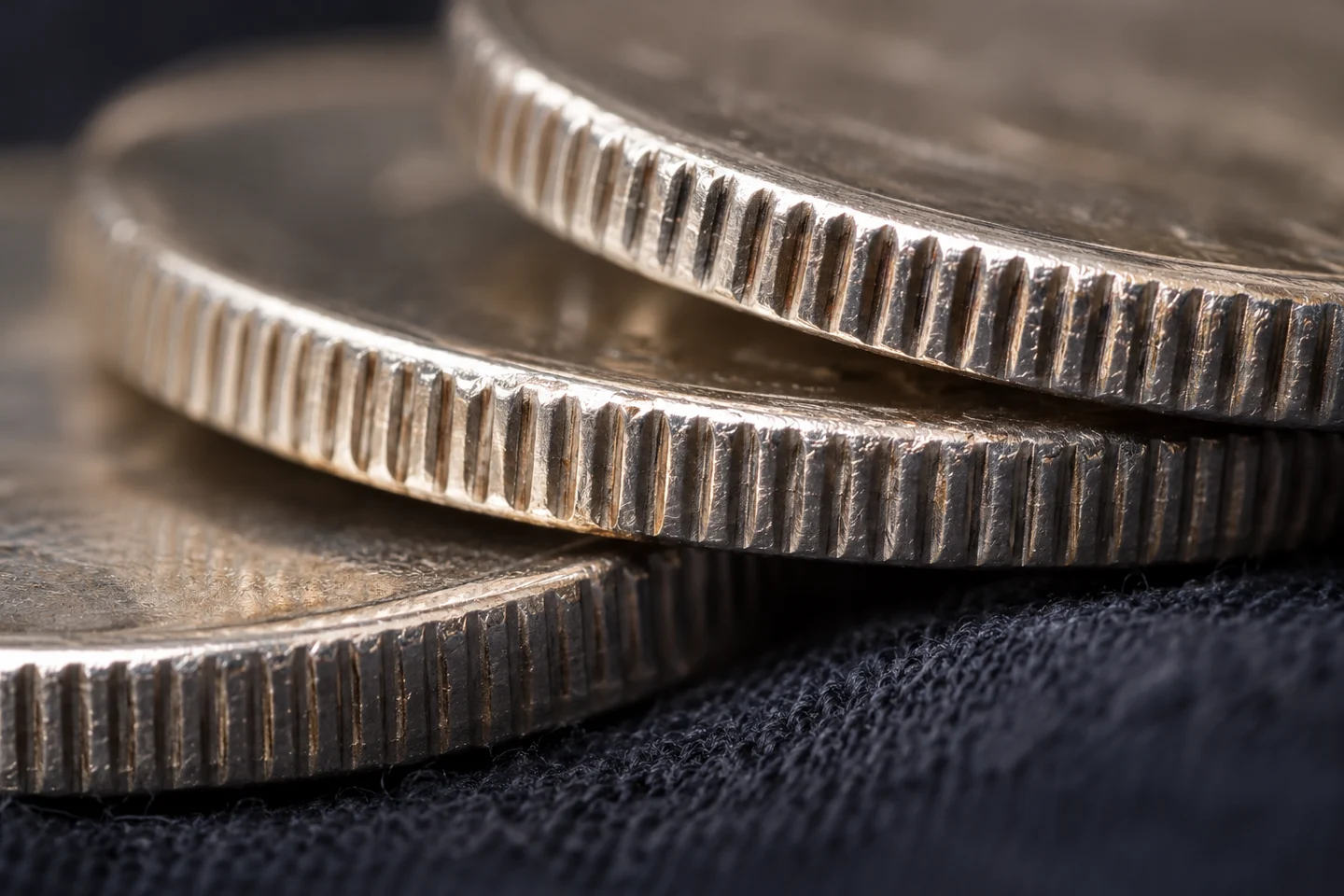
Close-up of ridged silver-coloured coin edges.
AI-generated illustration · illustrative scene, not a documentary photograph.

Look at the side

A coin has two faces, but it also has an edge. Some edges are smooth. Others have small lines, called ridges. You can often feel them with your finger.

These details have a history. In the past, some coins contained valuable gold or silver. People could cut small pieces of metal from an edge and still try to spend the coin. This was called clipping.

A pattern with a purpose

A patterned edge made that change easier to notice. If someone removed metal, the pattern could look damaged. Lines or lettering around the edge helped show that something was missing.

Today, coin edges have different designs. Not every coin has ridges, and not every modern coin contains a valuable precious metal. A feature can stay familiar even when the world around it changes.

A closer look

Imagine a museum display with two old coins. One is complete; the other has an uneven edge. A visitor might first notice the pictures. A coin expert might look at the side.

The next time you describe a small object in English, try three details: its shape, its surface and its edge. There is often more to say than its colour.


Vocabulary & expressions

edge
borda

Look at the edge of the coin.

smooth
liso

This side feels smooth.

ridge
saliência, ranhura em relevo

The coin has tiny ridges.

to notice
perceber

Did you notice the damaged edge?

Examples written by Better English Today.

02 · CHECK YOUR UNDERSTANDING

What stayed with you?

Choose one answer for each question. You can return to the text at any time.

1. Where are the ridges discussed in the article?
2. What was clipping?
3. Why could a patterned edge help?

Your turn to use it.

Describe a small object without naming it. Ask someone to guess what it is.

It is round… Its surface is… The edge…

Try it aloud or in your notebook. This is an open response, not an automatically graded task.

Sources & further reading

Source: The Perth Mint · Why do coins have serrations or grooves? · The Royal Mint · Coin collecting glossary

Original text, examples and activities by Better English Today. References support the factual background. Links do not imply partnership.