The comfort of a saying
The claim that the internet never forgets is both a warning and a reassurance. It cautions us that an ill-judged remark may outlive the moment in which it was made; it also encourages the assumption that whatever we need will still be there when we return. The two ideas sit together rather less comfortably than the saying suggests.
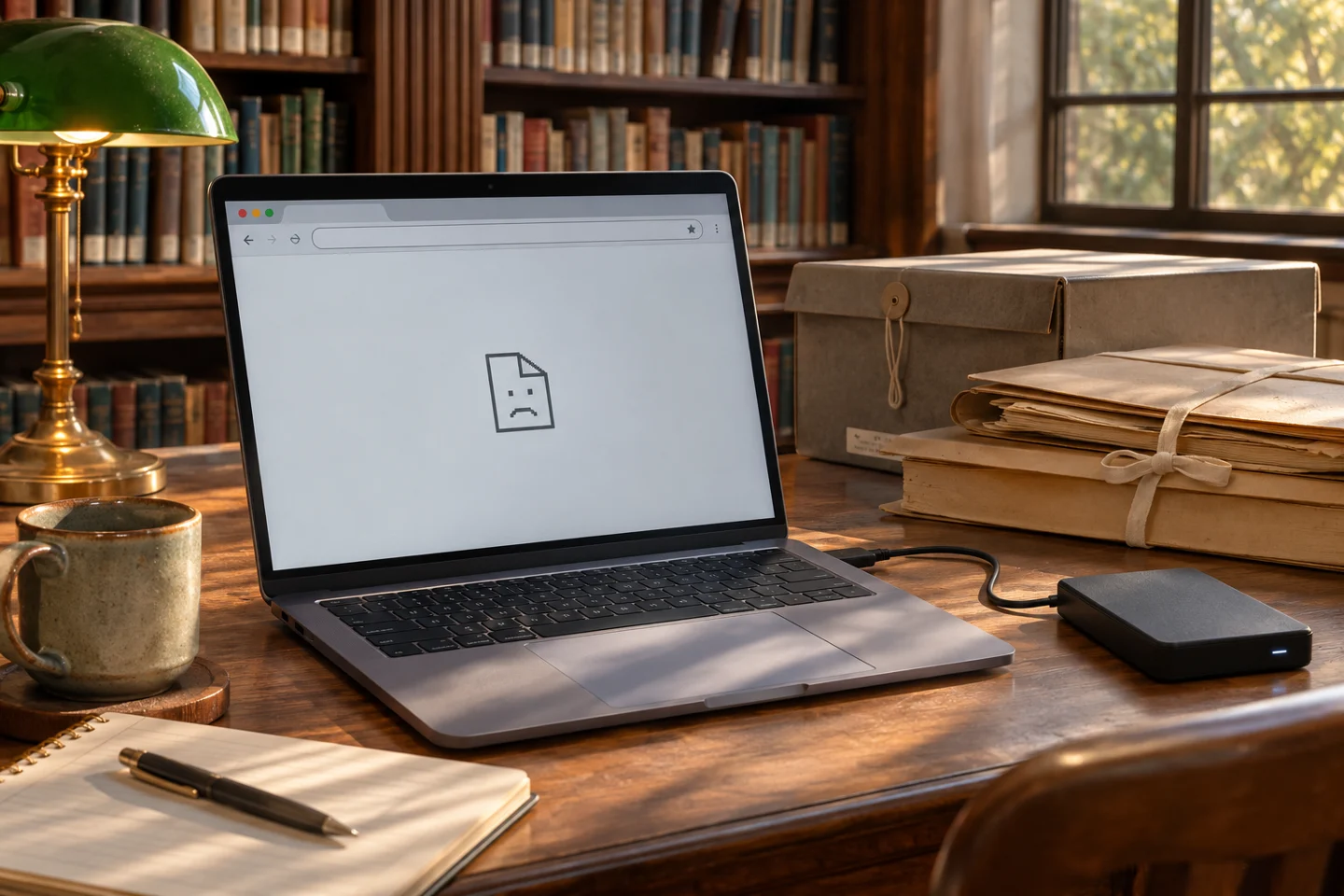
A link, after all, is an address rather than a promise. A website may close, its pages may be reorganised, or its contents may change while the address remains the same. A reference that once allowed readers to inspect the evidence can gradually become a dead end. This is often called link rot.
What counts as keeping something?
The Library of Congress selects and preserves web content so that future researchers can consult it. Capturing a website, however, involves more than keeping its words. Images, styles and other files contribute to the context in which those words were encountered. An archived version may preserve some features while failing to reproduce others.
It is tempting to regard that incompleteness as a merely technical inconvenience. Yet consider a hypothetical announcement whose qualifications were hidden behind an interactive panel. If the panel no longer opens, retaining the visible headline would not necessarily retain the meaning a careful reader could originally have found.
The UK Government Web Archive makes a related distinction: its archive is not a backup from which a live website can simply be restored. Preserving a record and recreating an operational service are different undertakings. “We saved the page” therefore invites a follow-up question: saved which aspects, and for what purpose?
Memory without innocence
BET’s discussion question is whether preserving more always means preserving better. Keeping a public record may help people scrutinise decisions, but an individual might reasonably object to being defined indefinitely by an old post. Conversely, removing something from a live service does not automatically settle whether a historical record should survive.
These are competing considerations, not a puzzle that the instruction “save everything” can resolve. Imagine that you are writing an archive’s policy: whose interests would you weigh, whose consent would you seek, and what omissions would you be prepared to defend?
The point is not to turn every broken link into a moral crisis. It is to notice how readily a convenient phrase can do our thinking for us. The internet can preserve traces we would rather lose while losing records we would rather preserve. Once that tension becomes visible, permanence looks less like a property of the medium and more like work that someone must choose to undertake.