An unfamiliar ending to the day
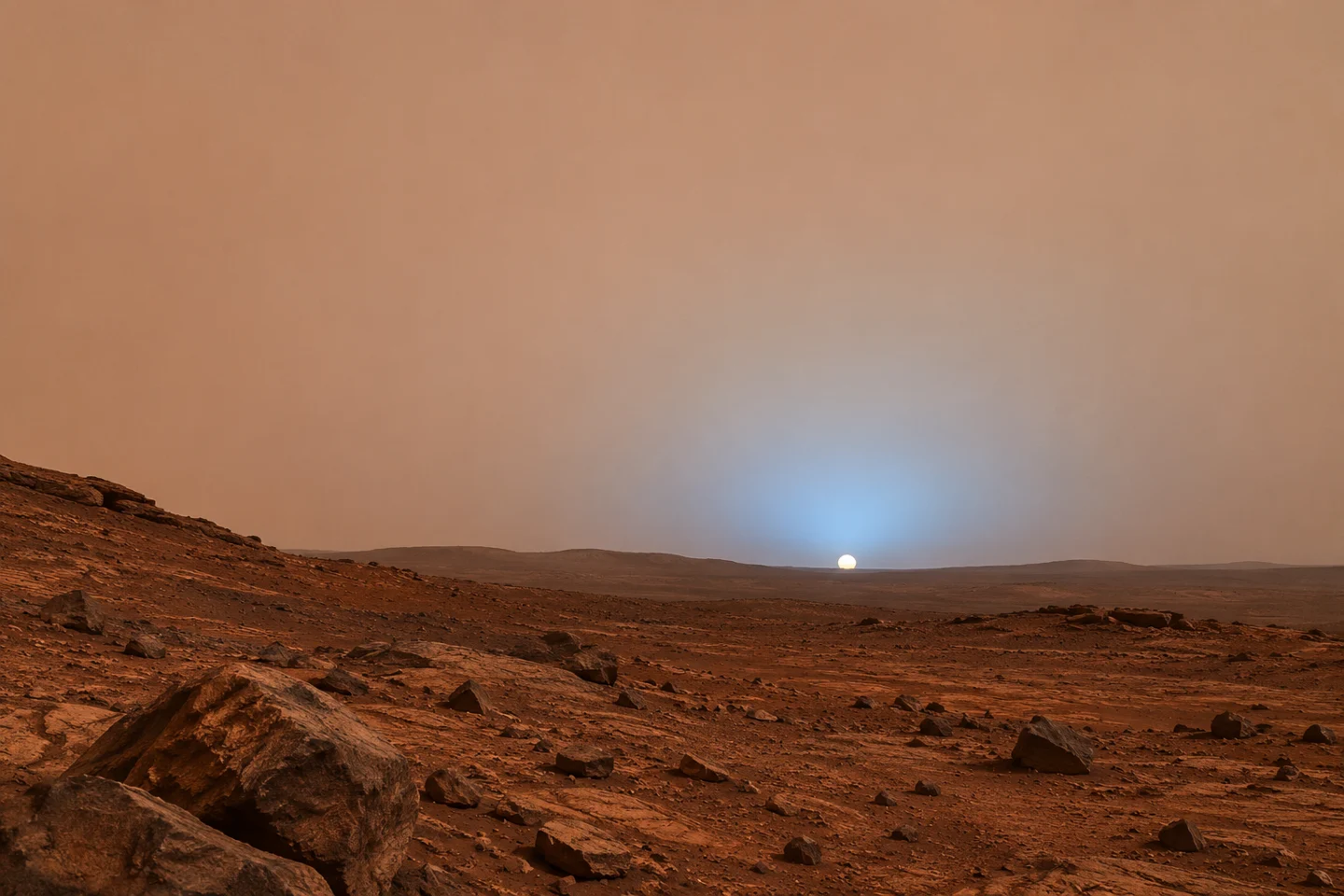
We often associate sunsets with warm reds and oranges. Mars offers a surprising contrast: images from its surface have shown a blue glow close to the setting Sun. The surrounding sky does not have to turn into a uniform blue dome for this effect to appear.
The colour depends on the journey sunlight makes through the atmosphere. On Earth, gases and particles scatter light. On Mars, fine dust plays a particularly important role in the appearance of the sky. The same source of light can produce different views under different conditions.
Dust changes the picture
NASA explains that the fine Martian dust allows blue light to reach the region near the Sun more efficiently than longer-wavelength colours. Around sunset, sunlight travels through a greater length of dusty atmosphere, making the effect more noticeable.
This is not a change in the colour of the Sun itself. It is a change in how light reaches an observer. The distinction matters whenever a picture seems to contradict something familiar: ask what happened between the source and the camera.
Twilight images also help researchers investigate dust and clouds. A beautiful view can therefore be useful evidence, provided we know how it was recorded and what the image represents.
A picture needs a caption
The cover of this article is an AI-generated illustration, not an image captured by a Mars mission. The NASA sources below provide actual mission images and the scientific background. The two kinds of image serve different purposes.
Imagine explaining the phenomenon to a friend who expects every sunset to be orange. Start with the observation, explain the role of dust, and finish by qualifying the claim: a blue glow near the Sun does not mean the entire Martian sky is always blue. Precision makes the surprise more interesting.