Brazilian, but not exclusively Brazilian
For many people in Brazil, a capybara is a familiar neighbour: a large brown animal beside a lake, on a riverbank or near a wet patch of grass. It belongs to Brazil’s native fauna. It is also found in other parts of South America, so describing it as exclusively Brazilian would confuse familiarity with geographical restriction.
The distinction is useful in English. An animal native to a country occurs there naturally. An animal endemic to a particular region is naturally restricted to that region. The capybara is native to Brazil, but it is not endemic to Brazil. A species can be an important part of a country’s identity without belonging to that country alone.
Built for more than dry land
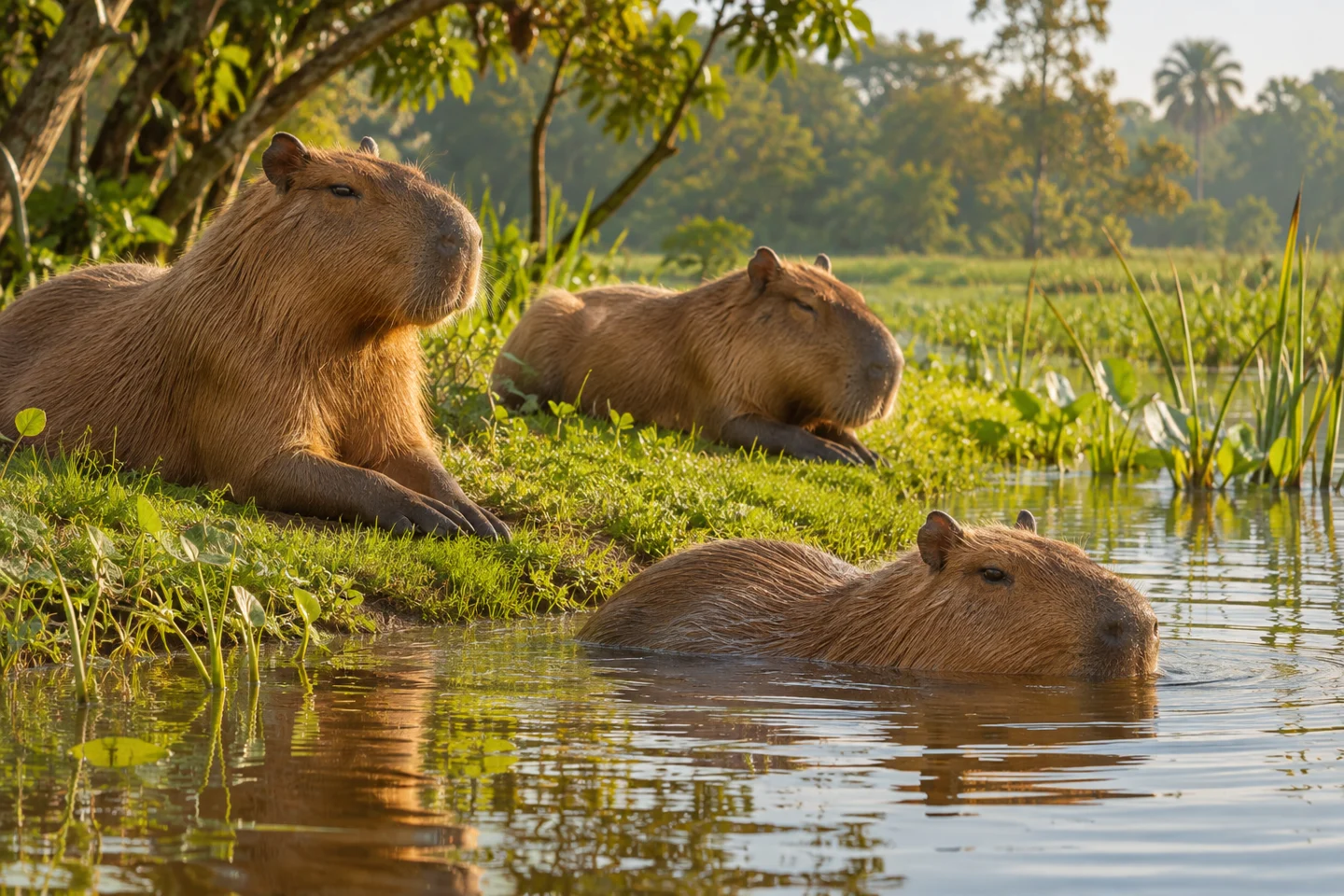
The capybara is the world’s largest living rodent. Its semi-aquatic life is reflected in its body: partly webbed feet help it swim, while eyes, ears and nostrils positioned high on the head allow much of the body to remain underwater.
Water is therefore more than a picturesque background. Capybaras use it as part of a habitat in which they feed, rest and escape predators. They eat vegetation, including grasses, and live in social groups. Their daily needs connect the bank, the water and the surrounding plant life.
That combination matters when we think about habitat. A patch of water isolated from suitable surrounding land is not necessarily equivalent to a functioning wetland. Looking at the animal alone can hide the relationships that make its presence possible.
More than an internet personality
Imagine two captions for the same illustrative scene. One says, “A relaxed capybara by a pond.” The other asks how the animal’s body, food and group life fit that place. The first notices an appealing moment; the second begins an ecological explanation.
We do not have to give up affection in order to become more curious. The useful step is to let the familiar image lead to better questions: where does this animal occur naturally, what does it need, and which parts of its environment are easily overlooked?
A Brazilian neighbour can also be a South American species. Keeping both descriptions in view makes the story more accurate, and gives us language for belonging without turning a shared natural world into a collection of exclusive possessions.